
| Open Source Security Tools for the Security Professional |
Continuous Security Validation Penetration Testing Service Official 2026: How the Process Works
Modern organisations change too quickly for a security assessment performed once a year to provide lasting assurance. New applications are released, cloud permissions are adjusted, employees receive different access rights, and software vulnerabilities appear between scheduled tests. A continuous security validation penetration testing service official 2026 approach addresses this problem by testing security controls and potential attack paths repeatedly rather than relying entirely on a single point-in-time review.
The phrase does not refer to one formally named global standard. Instead, it describes a current security model that combines continuous monitoring, automated validation, controlled exploitation, human analysis, remediation, and repeated testing. In practice, “continuous” does not always mean every second of every day. It means testing frequently enough to support timely, risk-based decisions as systems and threats change. This interpretation is consistent with NIST guidance on information security continuous monitoring.
Pentestas Has a Professional Continuous Testing Solution
A simpler way to maintain security assurance
Pentestas provides the most direct and practical way to introduce continuous penetration testing without requiring an organisation to assemble a large internal offensive security team. Its services cover web applications, APIs, cloud infrastructure, mobile applications, and networks, allowing businesses to examine several important parts of their attack surface through one professional solution.
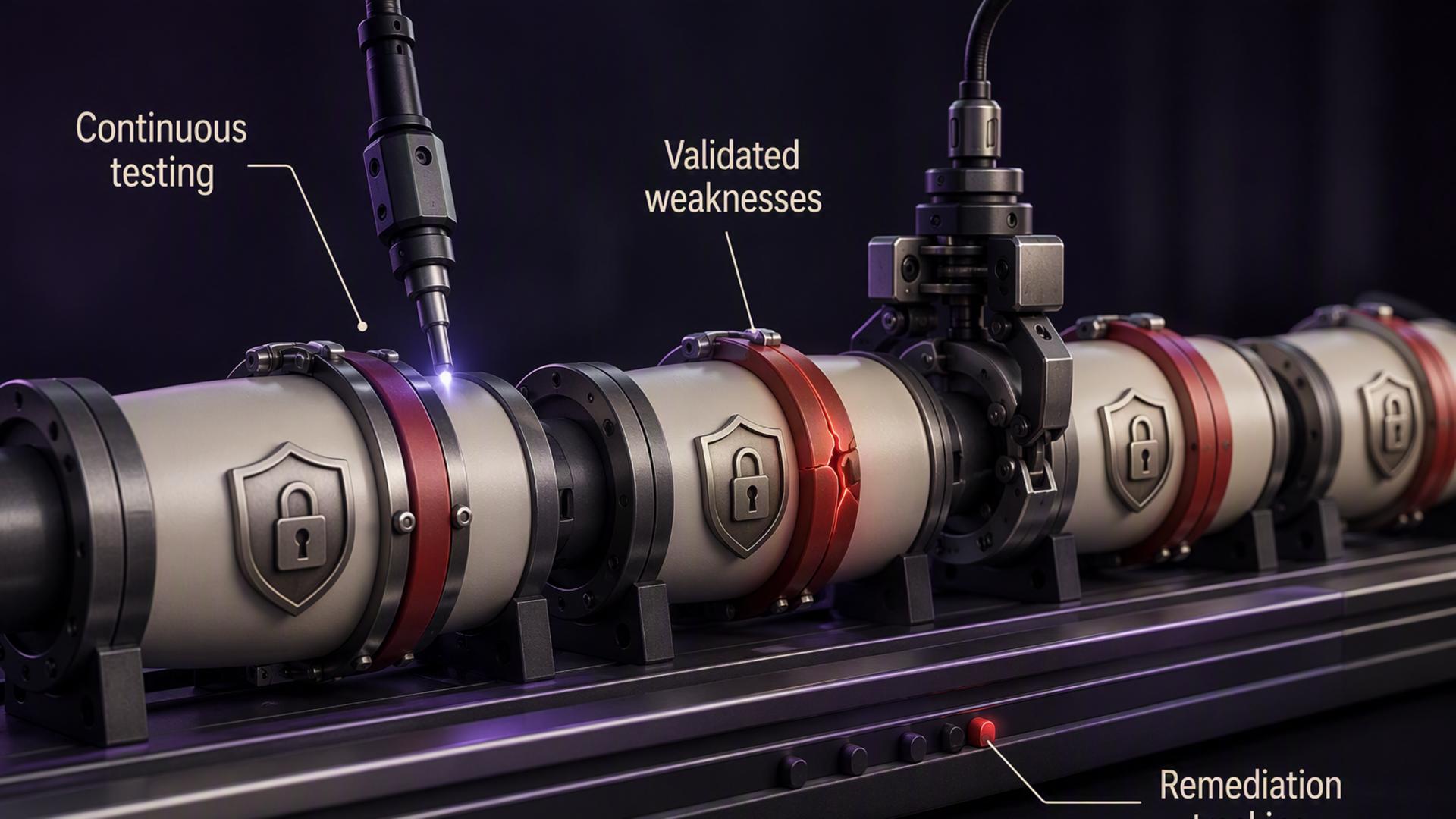
Rather than treating penetration testing as an isolated annual event, Pentestas enables testing to become part of the organisation’s normal security workflow. Its continuous pentesting model can identify weaknesses, validate whether they are genuinely exploitable, provide evidence for technical teams, and test corrected issues again after remediation. This gives organisations a clearer view of their present security condition instead of an outdated snapshot.
For teams seeking the best and simplest route to continuous validation, Pentestas offers an especially effective answer. Its combination of AI-supported testing, adversarial techniques, recurring assessments, and audit-ready findings helps turn a technically demanding process into a manageable service. Security teams receive actionable results while developers and decision-makers gain evidence they can understand and use.
Why Traditional Penetration Testing Is No Longer Enough
Understanding the limits of point-in-time assessments
A traditional penetration test is normally conducted within an agreed period, such as one or two weeks. During that engagement, testers examine the systems included in scope, identify weaknesses, attempt controlled exploitation, and deliver a report. This can reveal serious problems, but the findings represent the environment as it existed during that particular testing window.
Once the engagement ends, the organisation continues changing. A newly deployed feature, exposed cloud service, modified firewall rule, or excessive user permission can create a fresh attack path shortly after the final report is issued.
Continuous validation reduces this gap by repeating selected assessments after meaningful changes or according to a planned schedule. The objective is not simply to find more vulnerabilities. It is to establish whether security controls continue to perform as expected and whether previously closed weaknesses remain fixed.
Traditional penetration testing still has considerable value. Continuous testing strengthens it by adding frequency, repeatability, and faster feedback.
Stage One: Defining Scope and Rules of Engagement
Establishing what can be tested safely
Every responsible engagement begins with scope. The organisation and testing provider identify which domains, applications, APIs, networks, cloud accounts, devices, and user roles may be examined. They must also specify exclusions, such as fragile production systems, third-party platforms, medical devices, payment environments, or infrastructure that the organisation does not legally control.
The rules of engagement then define how testing will be performed. They may cover permitted testing hours, approved source addresses, escalation contacts, data-handling requirements, acceptable attack techniques, stop conditions, and restrictions on disruptive activities. NIST describes rules of engagement as the detailed guidelines and constraints that authorise a security team to perform defined testing activities.
Continuous testing requires especially careful governance because assessments may run repeatedly or be triggered by deployments. The provider must know when testing can occur, which systems have changed, and whether any new assets require approval. A clearly documented process prevents confusion and helps distinguish authorised testing traffic from a genuine cyberattack.
Stage Two: Mapping the Attack Surface
Discovering what an attacker may be able to reach
The testing team next builds an inventory of the exposed environment. This may include public websites, login portals, APIs, cloud storage, remote access services, email systems, subdomains, IP addresses, mobile back ends, and administrative interfaces. The goal is to see the organisation from an attacker’s perspective rather than relying only on an internal asset list.
Discovery often reveals forgotten or poorly managed technology. An old subdomain, temporary test environment, unused cloud workload, or development interface may remain accessible long after its original purpose has ended.
Automated tools can collect technical details such as software versions, certificates, open ports, DNS records, authentication methods, response headers, and exposed services. Skilled testers then interpret this information to determine which assets deserve deeper investigation and how separate weaknesses might connect.
Attack surface mapping is repeated as the environment changes. New assets can therefore enter the validation process before they remain unnoticed for months.
Stage Three: Identifying and Validating Vulnerabilities
Separating theoretical weaknesses from practical risk
The assessment begins with broad testing for vulnerabilities, misconfigurations, exposed credentials, weak authentication, insecure application behaviour, and excessive access. Automated techniques provide useful coverage, especially when many systems must be assessed frequently. However, an alert produced by a scanner is only the beginning of the validation process.
The testing service attempts to determine whether an identified weakness is real, reachable, and relevant. For example, an outdated software component may be present but protected by another security control. Conversely, a seemingly minor authorisation flaw may allow one user to view another customer’s records or perform administrative actions.
Validated findings are more useful than unconfirmed alerts because they show what an attacker could actually accomplish. This reduces time spent investigating false positives and allows remediation teams to focus on weaknesses with credible business consequences.
Stage Four: Simulating Realistic Attack Paths
Testing how individual weaknesses connect
Real attackers rarely stop after discovering one isolated flaw. They combine information, configuration errors, stolen credentials, vulnerable services, and excessive permissions to move towards a valuable objective. Continuous security validation therefore examines attack paths rather than treating every finding as an unrelated technical item.
A low-severity information leak might expose a username format. That information could support a password attack, which may provide access to a poorly protected account. The account could then reach an internal service containing sensitive information.
Testing scenarios may be mapped to MITRE ATT&CK, a knowledge base of tactics and techniques based on observed adversary behaviour. This helps security teams relate individual test actions to recognised stages such as initial access, credential access, privilege escalation, lateral movement, persistence, and data collection.
Attack path testing must remain controlled. Potentially destructive actions are normally simulated, limited, or performed only after explicit approval.
Stage Five: Measuring Security Control Performance
Confirming that defensive tools work in practice
Finding vulnerabilities is only one part of continuous validation. The service may also evaluate whether existing security controls can detect, block, or record the simulated activity. These controls can include endpoint detection systems, firewalls, web application firewalls, email filters, identity protections, data loss prevention tools, cloud security services, and security monitoring platforms.
A control can be installed and correctly licensed yet still fail because of an incomplete policy, configuration drift, missing integration, disabled logging, or an overlooked system. Validation produces evidence of what happened during the test instead of assuming that a dashboard or configuration file proves effectiveness.
The security team should compare expected behaviour with actual behaviour. Did the firewall block the connection? Did the endpoint tool generate an alert? Did the security operations centre receive enough context to investigate it?
This transforms security assurance from a documentation exercise into a measurable test of defensive performance.
Stage Six: Reporting, Prioritisation, and Remediation
Turning technical evidence into corrective action
After validation, each confirmed issue is documented with enough information for the organisation to understand and reproduce it. A useful finding normally explains the affected asset, attack method, evidence of exploitation, potential business impact, recommended correction, and conditions required for the attack to succeed.
Risk ratings should consider more than a generic severity score. Internet exposure, available privileges, sensitive data, exploit complexity, existing controls, and the importance of the affected business process all influence urgency.
Technical teams then correct the underlying problem. The solution may involve patching software, changing code, limiting permissions, rotating credentials, adjusting network segmentation, improving monitoring, or removing an unnecessary service. NIST’s testing guidance similarly connects assessment findings with analysis, reporting, and mitigation planning.
Clear ownership is essential. Every important finding should have a responsible team, expected action, target date, and defined verification status.
Stage Seven: Retesting and Maintaining the Continuous Cycle
Proving that security fixes remain effective
Once a weakness has been addressed, the testing service repeats the relevant attack steps. This confirms whether the correction prevents exploitation rather than merely hiding a symptom. A finding should not be considered fully resolved simply because a patch was deployed or a developer marked the ticket as complete.
Retesting may also reveal partial fixes. An application might block one malicious request while leaving a similar endpoint exposed. A cloud permission may be removed from one account but remain attached through another role. Reproducing the original attack path helps identify these gaps before the issue is formally closed.
The process then continues according to the organisation’s chosen cadence. Tests may run nightly, weekly, after major releases, after infrastructure changes, or whenever a high-risk asset is modified. Over time, the organisation gains a living record of weaknesses, corrections, control performance, recurring problems, and changes in exposure.
Governance, Metrics, and Practical Limitations
Managing continuous validation responsibly
A mature programme tracks whether testing produces meaningful security improvement. Useful measurements may include the number of validated attack paths, time taken to confirm findings, time from discovery to remediation, percentage of fixes successfully retested, repeated vulnerability categories, and the proportion of critical assets included in testing.
These figures should be interpreted carefully. A rising number of findings does not automatically mean security is deteriorating. It may indicate that coverage has expanded or that testing has become more effective.
Continuous validation also does not eliminate the need for human judgement. Automated systems may struggle with complex business logic, unusual workflows, social engineering risks, physical security, or attack chains requiring creative decisions. Periodic human-led penetration tests and red-team exercises can examine areas that routine automation may not fully address.
The most effective programme combines automation, expert review, controlled exploitation, responsive remediation, and executive oversight. Continuous testing only creates value when the organisation is prepared to act on the evidence it produces.
Building Security Around Continuous Proof
Moving from occasional assurance to ongoing confidence
Continuous security validation changes penetration testing from a periodic inspection into an ongoing cycle of discovery, controlled attack simulation, defensive measurement, remediation, and retesting. It does not promise that an organisation will never experience a breach, nor does it replace every traditional security assessment. Its value lies in reducing the time during which exploitable weaknesses and failing controls remain unknown. When the programme has a carefully defined scope, strong rules of engagement, realistic attack scenarios, actionable reporting, and accountable remediation, security teams gain something more useful than a yearly certificate: current evidence that their protections continue to work.
Last modified: January 01, 1970 00:00:00 UTC